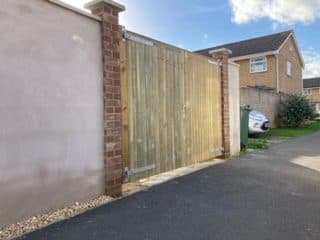
Plenty of gardens around North Somerset are on a slope, from the hillside streets of Clevedon and Weston-super-Mare to gardens running up towards the hill at Backwell. A fence on sloping ground needs more thought than one on a level lawn. There are two main approaches, stepped and raked, and each has its place.
Stepped fencing
A stepped fence is built in level sections, each one a little higher or lower than the last, like a staircase. It is the usual way to fit ready-made panels on a slope, because panels are rectangular and do not bend to follow the ground.
Things to know:
- Each step leaves a triangular gap at the bottom of the panel on the downhill side. This is usually filled with a gravel board, or two, cut and fitted to the ground.
- The top of the fence has a stepped look, which some people like and some do not.
- On a steep slope, the steps get bigger, so the gaps underneath get bigger too.
- The top of the fence ends up higher at the low end of each step, which matters if you are near the 2 metre height limit.
Raked fencing
A raked fence follows the slope, so the top and bottom run parallel to the ground. It is usually built on site, with the rails fixed at the angle of the slope and the boards fixed vertically, as with close-board or feather-edge fencing.
Things to know:
- There are no stepped gaps at the bottom, so the fence follows the ground neatly.
- It suits gentle, even slopes best. On a slope that changes angle, the fence follows those changes.
- It takes longer to build than a stepped panel fence.
My guide on feather-edge, close-board or panel fencing explains the fence types in more detail.
Which is better?
- Gentle, even slope and you want a neat line: raked close-board usually looks best.
- Steep or uneven slope: stepped sections are often easier, as long as the gaps underneath are filled properly.
- Panel fencing on a budget: stepped is the only practical option.
- Very uneven ground: a combination can work, raking some sections and stepping where the slope changes sharply.
When the levels are different on each side
Sometimes the problem is not a slope along the fence, but a difference in level across it, with one garden higher than the other. A timber fence is not designed to hold soil back. If soil is piled against the boards or gravel boards, they will rot and can be pushed over. In that case, the soil may need a proper retaining wall, with the fence on top or alongside it.
Height on a slope
In England, fences can usually be up to 2 metres high without planning permission, or 1 metre next to a road. On a slope, the height at the low end of each step or at the bottom of the garden is what can push you over. If the ground is a different level on each side, ask the council how they would measure it. My guide to fence height and planning permission explains the basics.
Gates on sloping ground
A gate on a slope can drag on the high side when it opens. It can be hung to open downhill, fitted with a larger gap underneath, or fitted with rising hinges. This is one reason it pays to plan gates and fencing together.
Privacy on sloping gardens
On a garden that rises towards a neighbour, a 2 metre fence may not give much privacy at the bottom of the garden. A privacy screen set close to the patio, rather than a taller boundary, is often the better answer.
Fencing sloping gardens in North Somerset
Sloping gardens are common around Backwell, Clevedon and the hillside streets of Weston-super-Mare. When I measure up, I look at the fall of the ground and suggest whether to step, rake or combine the two. See my fence installation page, and for smaller garden timber jobs, my property maintenance service. Ask for a free quote or call 07976 165908.