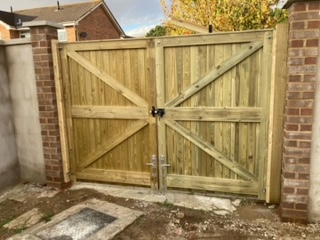
If you are replacing a garden fence, the first choice is usually between feather-edge or close-board fencing built on site, and ready-made panels such as lap panels. Each has its place. The right one depends on how exposed your garden is, what the ground is like and how much you want to spend now against how long you want it to last.
What the names mean
The terms get used loosely, so it helps to be clear about what each one is.
- Feather-edge boards are tapered, thicker at one edge than the other. They are fixed vertically and overlapped, so each board covers the thin edge of the one next to it.
- Close-board fencing is a solid fence of vertical boards fixed to horizontal rails between posts. In the UK it is usually built from overlapping feather-edge boards, which is why the two names are often used together.
- Lap panels, sometimes called overlap or waney-edge panels, are ready-made panels of thin horizontal boards in a frame. They slot between posts or are fixed to them.
Close-board and feather-edge: built on site
With close-board fencing, the posts go in first, then the rails, then the boards are fixed one by one. Usually a gravel board runs along the bottom to keep the boards off the soil.
The main advantages:
- It is strong. Boards are fixed to rails along their length, rather than relying on a thin panel frame.
- It follows the ground. On a slope, the rails can follow the fall of the land, so you are not left with stepped panels and gaps underneath.
- Single boards can be replaced. If one board splits or gets damaged, it can be swapped out without touching the rest.
- It suits awkward runs. Odd lengths, curves and changes of height are easier when the fence is built to fit.
The downside is cost and time. It takes longer to build, and the materials cost more than basic panels. It is also heavier, so posts need to be set properly.
Lap panels: quick and affordable
Lap panels are the most common fence in British gardens because they are cheap and fast to fit. On a level, sheltered boundary, they do a perfectly decent job.
Where they struggle is wind. A solid panel acts like a sail, and thin horizontal boards can split or pop out of the frame in a strong gust. Once a few slats have gone, panels are hard to repair neatly and are usually replaced whole. On a sloping garden, panels have to be stepped, which leaves triangular gaps to fill underneath.
How long does each one last?
A Which? Trusted Traders guide says a good-quality fence that is treated and well maintained should last 15 to 20 years, and it singles out feather-edge fencing on solid posts as one of the longest-lasting options. In practice the posts usually decide how long a fence lasts, rather than the boards or panels, which is why I look at the ground before recommending a post type for any new fence.
Which suits North Somerset gardens?
A lot of gardens round here are either exposed or wet, and sometimes both.
- Exposed coastal gardens. On the hills and seafront in Clevedon and Weston-super-Mare, wind off the Bristol Channel is the main threat. Close-board on well-set posts generally copes better than lap panels.
- Wet, low-lying ground. Around Yatton and the Levels, soft damp soil is hard on posts. Gravel boards and the right post type matter more than the style of fence.
- Sheltered, level gardens. On a sheltered estate boundary, lap panels can be a sensible choice if budget is the priority.
- Privacy above a patio. If the aim is to block one particular view, privacy screening close to where you sit may work better than raising the whole boundary.
Repair or replace your existing fence?
If your current fence is close-board and only a few boards or a post have gone, a fence repair is often all it needs. If it is a run of tired lap panels on rotting posts, replacing it is usually better value. My earlier guide on what to do when a fence blows down explains how to tell the difference.
Talk it through on site
The best way to decide is to look at the garden itself: the exposure, the ground and what you want from the fence. I will give you an honest view on which option makes sense, including when cheaper panels will do the job. Ask for a free quote or call 07976 165908.