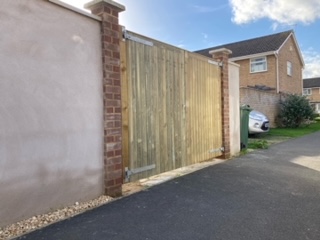
There is no law in the UK that says your fence is the one on the left or the one on the right. Which fence is yours depends on what your title deeds, title plan and original sale documents say, so that is where to look first.
The left or right idea is so common that plenty of people treat it as a rule. It is not. Some builders did lay estates out that way, and the form sellers fill in asks about the boundaries on the left, right and rear, which is probably where the confusion comes from. But every house is different, and the paperwork for your house is what counts.
Is the fence on the left or right mine?
Not automatically. You will hear people say you own the left-hand fence as you look at your house from the road, or that you own the right-hand one. Neither is a legal rule. Two houses on the same street can have opposite arrangements, and some boundaries are shared between both neighbours.
So rather than guessing, check the documents below. It usually takes less time than you would think.
How to check which side of the fence is yours
Work through these in order. Most people find the answer in the first two or three.
- Your title register and title plan. Most homes in England and Wales are registered with HM Land Registry. You can download the register and plan for a registered property on GOV.UK for a small fee.
- T marks. A T mark on one side of a boundary line usually means the owner of the land on that side owns or must maintain that boundary, but only if the wording of the deed refers to it. An H mark, or two T marks facing each other, usually means it is shared.
- The original transfer or conveyance. T marks are often in the deed from when the house was first sold, not on the modern title plan. Your title register may refer to that deed, and Land Registry can sometimes supply a copy.
- The builder's original plans. On newer estates, the developer's plot plans often show which boundaries each house was given.
- The seller's property information form. When you bought the house, the seller should have filled in a form (usually called the TA6) saying who they believed owned or maintained each boundary. Your conveyancer should have a copy.
Bear in mind that Land Registry title plans show general boundaries. They show roughly where the line runs, not its exact position. And the seller's form only tells you what the seller believed. It is useful, but it is not proof.
Does the good side of the fence have to face out?
It is a common custom for the smooth, finished side of a fence to face the neighbour, with the posts and rails on the owner's side. Many people see it as good manners, and it often means whoever put the fence up kept the posts on their own land.
But it is a custom, not the law. There is no general legal rule about which way a fence faces, unless your deeds include a covenant that says so. The way a fence faces can be a clue, but it does not prove who owns it.
What to do if it is still not clear
Plenty of deeds say nothing useful about boundaries. If that is your situation, the simplest route is usually the best one.
- Talk to your neighbour. Most boundary questions get sorted over the fence. Compare what your paperwork says with theirs. If nobody can show who owns it, Land Registry guidance says it is best treated as shared, and changed only with both neighbours agreeing.
- Agree it in writing. Once you agree who looks after which fence, write it down, both sign it and keep a copy each. A solicitor can draw up a formal boundary agreement if you want more certainty for when you sell.
- Get help before it becomes a dispute. If you genuinely cannot agree, a chartered surveyor who deals with boundaries, or a mediation service, can help. Going to court over a fence is rarely worth the cost or the stress.
One thing that surprises people: in most cases nobody is legally required to put up a fence at all, unless the deeds say so. Being responsible for a boundary usually means you are the one expected to look after it if there is one.
Can I put up a fence on my own side?
Yes. If the boundary fence belongs to your neighbour, or you simply want more privacy, you can put up your own fence on your own land. You do not need your neighbour's permission, as long as the whole fence, posts and concrete included, sits inside your boundary and you do not fix anything to their fence or shed.
It is still worth a friendly word before you start. You may need to step onto their side to build it, and that does need their agreement.
Height is the thing to watch. In England, under permitted development rules, you can usually put up a fence, wall or gate up to 2 metres high without planning permission. Next to a road used by vehicles, or the pavement beside one, the limit is usually 1 metre. Different rules can apply to listed buildings, conservation areas and some newer estates where these rights have been removed, so check with North Somerset Council if you are unsure. If you put a fence on top of a wall, the combined height is usually what counts, so check with the council first. My guide to fence height and planning permission goes into more detail.
Need a fence replaced or repaired?
Once you know which fence is yours, the next question is usually what to do with it. I cannot tell you where the legal boundary line is, but I am happy to talk through the options on site. Have a look at my fence installation and fence repair pages, or the work I do in Clevedon and Portishead. Quotes are free, so give me a call on 07976 165908.