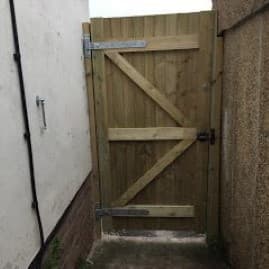
A timber gate that drags on the ground or will not latch is one of the most common jobs I get asked about. The good news is that the cause is usually easy to spot once you know what to look for. The four usual suspects are the brace, the hinges, the post and the gate itself.
1. The brace is the wrong way round
Most timber garden gates are ledged and braced, with horizontal rails across the back and a diagonal brace between them, often in a Z shape. That diagonal does a lot of work, and it only works if it runs the right way.
The brace should run from the bottom of the hinge side up to the top of the latch side. Fencing supplier Jacksons explains why: that way the brace is in compression, which timber resists well, and it carries the weight of the gate down towards the bottom hinge. Fitted the other way, the brace is pulled rather than pushed, and the far end of the gate drops.
Stand on the side of the gate with the rails and look at the brace. If it rises from the latch side towards the top hinge, it is upside down. That is a surprisingly common fault on cheaper gates and DIY builds. On some gates the brace can be removed and refitted, but often it is easier to rebuild or replace the gate.
2. Hinges that are too small or have worked loose
Hinges take all the weight of the gate. If they are too light for the size of gate, the screws pull out of the wood or the hinge bends. Check for:
- Screws that turn without tightening, or that have pulled partly out of the post.
- Hinge straps that are bent or rusted thin.
- Short screws on a heavy gate.
Sometimes heavier hinges and longer screws or coach bolts are enough. For driveway gates and larger side gates, I use heavy-duty galvanised hinges sized for the weight.
3. The hanging post is moving
If the gate is fine but the post it hangs from leans or rocks, the whole gate will drop. This is especially common with timber posts that have started to rot at ground level, or posts that were not set deep enough to carry the extra weight of a gate.
Push the top of the hanging post. If it moves, the post is the problem, and no amount of hinge adjustment will cure it. The fix is a new, properly set post, which is often a job I do as part of a fence repair. Gates fixed to brick pillars can have a similar problem if the fixings have worked loose in old mortar. I always check the pillar is sound before hanging anything from it.
4. The gate itself has warped or rotted
Timber moves with the weather. A gate can swell in winter and catch on the post, then shrink in summer and leave a gap. That is normal within limits. But if the joints have opened up, the bottom of the gate is soft, or the whole frame has twisted, it is probably at the end of its life.
Quick checks you can do
- Open the gate halfway and lift the latch end. If it rises easily and the hinges clunk, the hinges or screws are loose.
- Push the hanging post. If it moves, the post needs attention.
- Check the brace direction from the back of the gate.
- Look at the bottom rail and the base of the posts for soft or crumbly wood.
Repair or replace?
Tightening or upgrading hinges, adjusting a latch or re-setting a single post are all sensible repairs. If the brace is the wrong way, the frame is rotten or the gate never fitted the opening properly, a new gate made to measure is usually the better answer.
Older houses, like many in Backwell and Clevedon, often have openings that are not square, so off-the-shelf gates rarely fit well. A bespoke gate measured on site avoids the gaps and dragging that come from forcing a standard size into the space.
If the fence either side is also tired, it can make sense to do both at once. My guide to concrete versus timber posts explains what is best for hanging gates, and my fence installation page covers new boundaries.
Get your gate looked at
I make, hang and repair side, garden and driveway gates across North Somerset. See my gate supply and fitting page, then ask for a free quote or call 07976 165908.