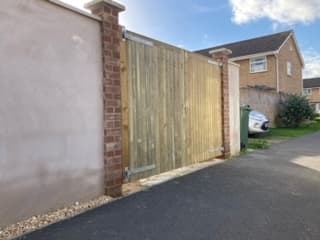
If you have never had a fence replaced before, it helps to know what is involved. Most domestic fence jobs follow the same pattern: a visit to measure up and talk through options, the old fence coming down, new posts going in, the fence going up, and a clear-up at the end. Here is how that usually works with me.
The first visit
I come out, look at the boundary and measure the run. While I am there, I look at the things that affect what kind of fence will last:
- How exposed the garden is to wind.
- What the ground is like, wet or dry, soft or stony.
- Whether the ground slopes, and by how much.
- Access, including whether materials have to come through the house or down a narrow side path.
- What is near the fence, such as trees, sheds, walls and planting.
- Whether any gates need replacing at the same time.
We talk about the style, height and posts, and I give you an honest quote. If a repair would do the job instead, I will say so.
Before work starts: check the boundary
If the fence is on a boundary with a neighbour, make sure you know who owns it before work starts, and let your neighbours know when it is happening. My guide on which fence is mine explains how to check your deeds. It is also worth checking the height rules in my guide to fence height and planning permission, especially if you are thinking of going taller, live near a road or have a listed home.
Getting your garden ready
A little preparation makes the job quicker and protects your garden.
- Move pots, furniture and anything else you value away from the fence line, ideally leaving a clear strip of a metre or so.
- Cut back climbers and shrubs that are growing through the old fence, or let me know which plants you want protecting.
- Check where any underground services run if you know, such as outside lights or garden power cables.
- Make sure there is a clear route from the road to the garden for materials.
Taking the old fence down
The old panels or boards come off first, then the posts are pulled or broken out, including the old concrete where necessary. Everything is loaded and taken away. As a registered upper-tier waste carrier I dispose of it legally, and I can provide proof of disposal. You can read why that matters in my guide to checking a waste carrier licence.
Setting the posts
Posts are the most important part of the job. They are set to the right depth for the fence height and the ground, lined up and plumbed, and concreted in. Whether they are concrete or timber depends on what we agreed. My guide to concrete versus timber posts covers the pros and cons.
Building the fence
For panel fencing, gravel boards and panels go in between the posts. For close-board, the rails go up first, then the gravel boards, then the boards one by one. On a sloping garden, the fence is either stepped or built to follow the slope. Any gates are hung at the end, once the posts either side are solid.
How long does it take?
Most domestic boundaries take one to three days. It depends on the length of the run, the type of fence, the ground, how much old fence and concrete has to come out, and access. Close-board built on site takes longer than panel fencing. Bad weather can also cause delays, as it is not sensible to set posts in waterlogged ground. I will give you a realistic timescale with the quote.
Finishing and clearing up
Once the fence is up, I check the line and the levels, and clear up the site, including offcuts and spoil. Treated timber can look a bit patchy at first and will weather over time. If you want to stain or paint it, it is usually best to wait until the timber has had time to dry out, so ask me about timing when the job is finished.
Fence installation across North Somerset
I install fences across North Somerset, including Portishead and Nailsea, and on the south-west edge of Bristol. See my fence installation page, and if you need new gates at the same time, they can be built to match. Old materials go through my licensed waste clearance. Ask for a free quote or call 07976 165908.