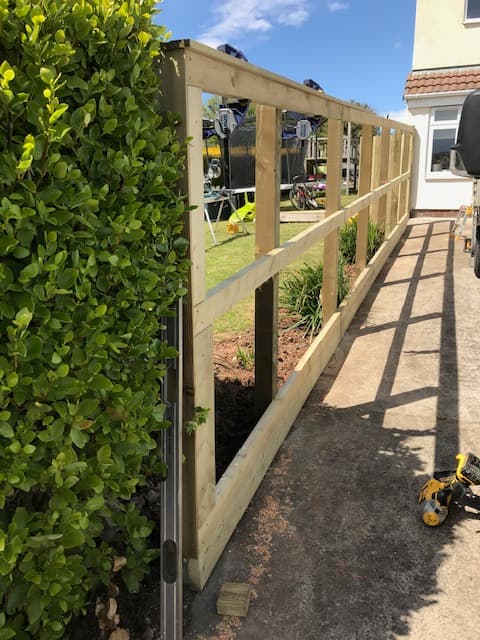
When a fence fails, it is usually the posts that go first. Panels and boards can be replaced, but if the posts have rotted at ground level, the whole run starts to lean. So when you are planning a new fence, the choice between concrete and timber posts is one of the most important decisions you will make.
How timber posts fail
Timber posts rot where the wood stays damp longest, which is at and just below ground level. Above ground the post can dry out between showers. Below it, the soil keeps it wet. That is why storm-damaged timber posts so often snap off cleanly at the base.
How quickly that happens depends on the timber, the treatment and the ground. Wet clay or peat, like the soils on the Levels around Yatton and Congresbury, is harder on timber than free-draining ground.
What to look for in treated timber posts
Not all treated timber is the same. In the UK, the treatment standard BS 8417 sorts treated wood into use classes. According to LABC, Use Class 3 is for timber exposed to the weather but not in contact with the ground, and Use Class 4 is for timber in permanent contact with the ground or fresh water.
Fence posts go in the ground, so they should be treated to Use Class 4. Boards and rails above the ground can be Use Class 3. Timber that is described as pressure treated is not automatically Use Class 4, so it is worth asking the supplier, or whoever is fitting your fence, what class the posts are.
How concrete posts work
Concrete posts do not rot, which is their big advantage. Most are slotted, so fence panels slide down into grooves on each side, and a matching concrete gravel board sits along the bottom. You can also get concrete posts with notches for building close-board fencing on timber rails.
Things to bear in mind:
- They are heavy, so they take more effort to install, especially where access is tight.
- In a very strong wind, a slotted panel can lift out of the grooves. The upside is that it can often be dropped back in without damage to the post.
- They look plainer. Some people do not like the look of grey concrete, though they can be partly hidden by planting or by fixing boards on one side.
- A concrete post can crack if hit hard, but this is much less common than a timber post rotting.
Timber posts: why they are still popular
Timber posts look more natural, they suit close-board and feather-edge fencing built on site, and they are easier to cut and fix to. For gates, a solid timber post is often the better choice because hinges and latches can be fixed directly into it. Set properly, with the right treatment and a well-shaped concrete collar that sheds water away from the post, they can last a good while.
Setting posts properly matters more than the type
Whichever type you choose, how the post goes in makes a big difference. A Which? Trusted Traders guide recommends that for a 6 foot fence, about 2 feet of post should be in the ground, set in concrete. A few other points help:
- Shape the top of the concrete so water runs away from the post, rather than pooling against it.
- Use gravel boards so the boards or panels are kept off the soil.
- On soft or wet ground, go deeper or use concrete posts.
- In exposed gardens near the coast, such as Portishead, closer post spacing and a heavier fence can help.
What about repairing a snapped timber post?
If one timber post has snapped at the base and the rest are sound, it can often be replaced on its own, or reinforced with a concrete repair spur bolted alongside. That can be a good, cheap fix. If several posts have rotted, though, the others are likely to follow, and replacing the run is normally better value. My fence repair page and my guide on whether a blown-down fence needs repair or replacement go into this in more detail.
Which should you choose?
- Wet or heavy ground, or you want the longest life from the posts: concrete is usually the safer choice.
- Close-board fencing on a sloping or awkward boundary, or posts for hanging gates: good timber posts, treated to Use Class 4 and set properly, work well.
- Exposed, windy gardens: either can work, but the fence style and post spacing matter as much as the post itself.
For more on fence styles, read feather-edge, close-board or panel fencing. When I quote for a new fence, I look at your ground and exposure before recommending a post type. Get in touch or call 07976 165908 for a free quote.