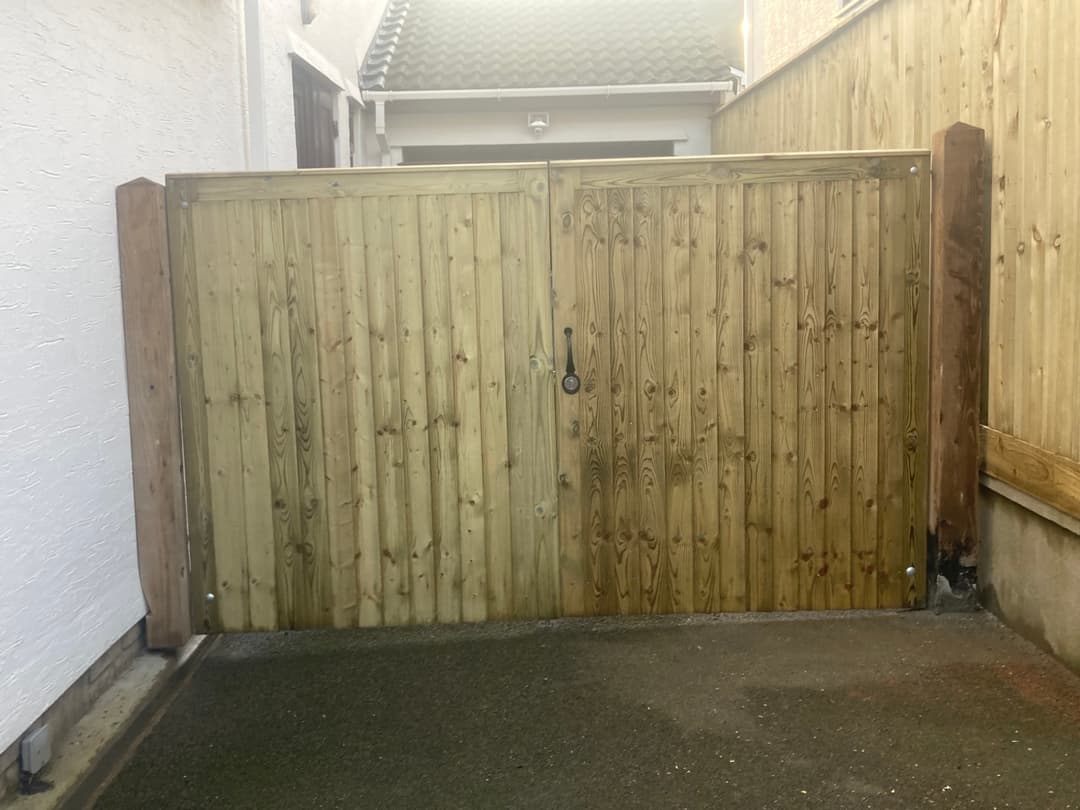
Wooden driveway gates are a big part of how a house looks from the road, and they get used every day. A good pair should swing freely, close without slamming and latch properly for years. A poor pair drops at the middle within a season or two. The difference is usually in the planning, the posts and the hardware rather than the timber itself.
Single gate or a pair?
On a narrow driveway, a single gate can work, but it needs a lot of clear space to swing and puts a lot of weight on one set of hinges. On wider openings, a pair of gates is usually better. Each leaf is lighter, needs less room to swing and puts less strain on the posts. A pair can also be set up so one leaf is used for walking through and both are opened for the car.
Which way should driveway gates open?
Into your property. Under section 153 of the Highways Act 1980, a gate that opens onto a street must not open outwards. That also makes sense in practice, as you do not want gates swinging into the pavement or the road.
So the first thing to check is whether there is enough level ground inside the opening for the gates to swing. If the drive rises steeply behind the gate, the bottom of the gate may hit the ground. The gates can sometimes be made shorter, hung slightly higher or fitted with rising hinges, but it is better to plan for it at the start.
Height rules next to a road
Gates, fences and walls next to a road used by vehicles are usually limited to 1 metre high without planning permission. Further back from the road, the limit is usually 2 metres. If you want tall, solid driveway gates right at the front of the property, check with the council first. Listed buildings and conservation areas have extra rules. My guide on fence height and planning permission explains them in more detail.
Posts and pillars
Driveway gates are heavy, and that weight levers on the hanging post every time they open. The post or pillar needs to be strong and well founded.
- Timber gate posts should be heavier than ordinary fence posts and set deep in concrete.
- Brick or stone pillars can work well, but only if they are sound. I check the pillar and the fixings before hanging anything from it, as old mortar can let fixings work loose.
- Hanging gates from a fence post that was never meant to carry them is a common cause of sagging.
Bracing and frame
Most timber driveway gates are framed and braced. The brace should run from the bottom on the hinge side up to the top on the latch side, so the timber is in compression and carries the weight down to the bottom hinge. My guide on why garden gates sag explains why this matters so much.
Hardware: hinges, latches and locks
The ironmongery is usually the first thing to fail on a cheap gate. For driveway gates, I use heavy-duty galvanised hinges sized for the weight of the gate, and drop bolts to hold one or both leaves in place. Ask about:
- Hinges rated for the weight and width of each leaf.
- Drop bolts that sit into the ground to stop the leaves moving in the wind.
- A latch or lock that suits how you use the gate, and that can be reached from both sides if needed.
- Gate stops so the gates close in line and do not swing past each other.
Style and privacy
Solid close-boarded gates give the most privacy and security. Gates with a gap or slatted top let light through and look less heavy, which can suit older cottages and stone houses. Older houses in places like Backwell often have openings that are not square, so a gate built to measure usually fits better than a standard size.
Wind exposure
Solid driveway gates catch the wind. In exposed spots, such as parts of Weston-super-Mare near the seafront, strong hinges, drop bolts and well-set posts matter even more. A slatted design can also reduce the load.
Driveway gates in North Somerset
I measure, build and hang driveway gates across North Somerset, from village homes around Congresbury to town houses. If the fence either side needs replacing too, it can be done at the same time, see fence installation, or if the fence just needs patching, fence repair. Read more on my gate supply and fitting page, then ask for a free quote or call 07976 165908.