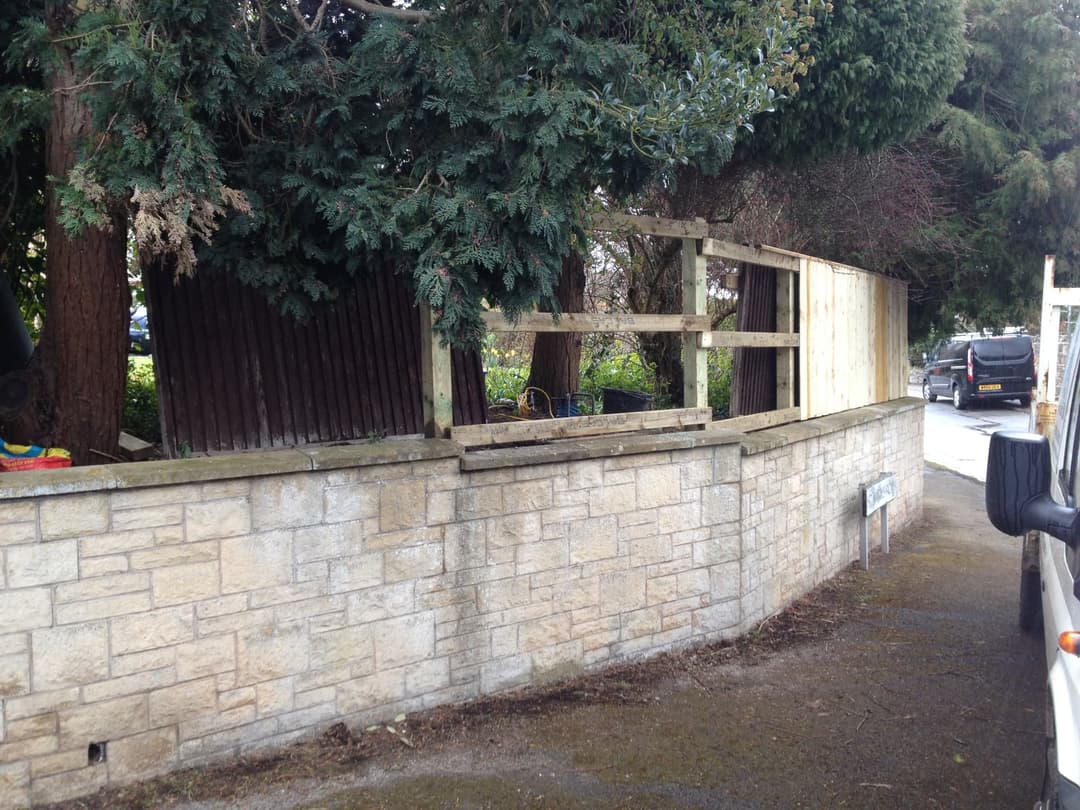
Most fences that come down in a storm were already weak. The wind just finds the problem. Around the North Somerset coast, the windiest months usually run from November to March, with the prevailing wind from the south-west off the Bristol Channel. A walk along your fence now, before the worst of the weather, can save you a much bigger job later.
1. Check the posts first
Posts hold the whole fence up, so start there.
- Push the top of each post. A little give is normal on a long run, but a post that rocks or moves at the base is a warning sign.
- Look at the base of timber posts. Soft, dark or crumbly wood at ground level means rot has set in. If a screwdriver pushes in easily, the post is weak.
- Check the concrete around the base. Cracks, or concrete that has lifted, can let a post move.
- Look along the line of the fence. A run that leans one way usually means more than one post has gone.
One weak post can often be replaced or reinforced on its own. Several weak posts usually mean the run needs rebuilding. My guide to concrete versus timber posts explains the options.
2. Look at the panels and boards
- On panel fencing, check panels are seated properly in their posts or brackets and that fixings have not rusted through.
- Look for split slats or panels bowing in the middle. A panel with a hole in it catches the wind in odd ways.
- On close-board fencing, replace any loose or split boards and check the rails are firmly fixed to the posts.
3. Secure gates
Gates take a battering in high wind, especially if they are left unlatched and swing hard against their stops. Check the hinges and latches, tighten anything loose and make sure the gate can be latched or bolted firmly shut. If a gate is dragging or dropping, my guide on why a garden gate sags explains the usual causes.
4. Clear what is leaning on the fence
Soil, compost bins, log piles and overgrown shrubs pushed up against a fence hold moisture against the timber and add load. Pull them back a little where you can. Heavy climbers can act like a sail in a storm. Trim them back if they have grown thick over the summer, but check for nesting birds first if it is early in the autumn.
5. Check what could fall onto it
Look up as well as along. Dead or overhanging branches can come down in a storm and flatten a fence. If a tree is on your neighbour's side, have a friendly word. If you live in a conservation area, such as central Clevedon, or a tree has a tree preservation order, you will usually need to notify or get consent from North Somerset Council before work on it.
6. Make a plan for the weak spots
If you have found a problem, autumn is a good time to deal with it, before the ground gets waterlogged and before the storms. Exposed gardens, such as those on the hills and seafront in Clevedon and Weston-super-Mare or on the waterfront side of Portishead, are where fences are most likely to fail.
Often a fence repair, replacing a few posts or panels, is all that is needed. If the whole run is tired, a new fence built for the exposure, such as close-board on well-set posts with gravel boards, will cope far better than patching old panels.
Check your insurance
It is worth reading your home insurance policy now rather than after a storm. Many policies exclude fences and gates from storm cover, or will not pay where the damage was down to wear and tear such as rotten posts. Knowing where you stand helps you decide whether to fix weak spots now.
If the worst happens
If your fence does come down, my guide on what to do when a fence blows down covers making it safe and deciding between repair and replacement. I also hang and repair gates. For a free look at your fence before winter, get in touch or call 07976 165908.